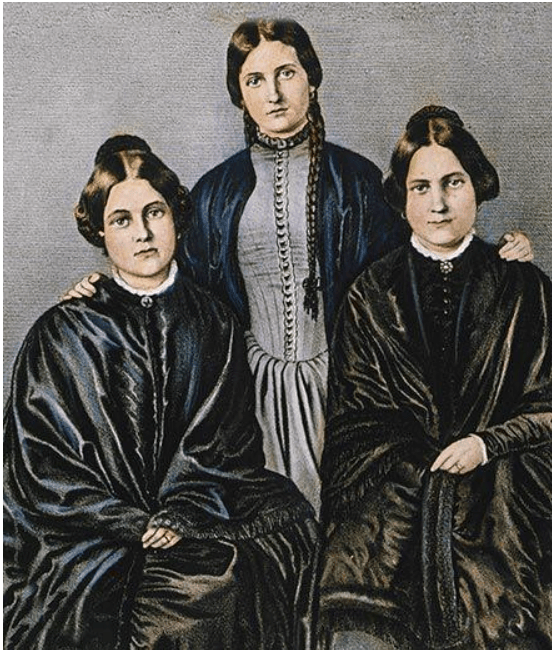
At the midpoint of the 19th century, Americans had become passionately eclectic in their spiritual inclinations. The Second Great Awakening saw the emergence and growth of the Mormon church, the Shaker religion, and William Miller’s Adventism. It was as though the New World was brimming with spiritual potential and technologies like the telegraph began to connect people in haunting new ways. It is no surprise, then, that a conversation between two teenage girls and a spirit carried out in raps and bumps would inspire one of the most popular American religions of the 19th century. This dispatch looks at how the Fox sisters’ special powers set the stage for later female spiritual authorities.
Meeting (& making) Mr. Splitfoot.
In the spring of 1848, Kate and Margaret Fox, two sisters living in Hydesville, New York, confessed to their parents that they had been communicating with a spirit they called Mr. Splitfoot. The night before this confession, the house had been disturbed by a series of strange noises. Their mother, Mrs. Fox, who lost sleep because of the racket, became convinced that the house was haunted. Mrs. Fox’s conclusion was informed by the reputation that the house had sustained over a period of years. The Foxes had taken up residence several months earlier, after the former tenant vacated, citing unexplained bumps in the night as the reason for leaving.
After witnessing communication between her daughters and the disembodied spirit, Mrs. Fox began to ask questions. The spirit responded with raps. Mrs. Fox asked the spirit if it was human. The spirit did not respond. When asked if it was a spirit, Mr. Splitfoot replied with two raps in the affirmative.
As Mrs. Fox asked more questions of the spirit, a detailed account of his life materialized. According to Mr. Splitfoot, at 31 years of age he was murdered in the house; what remained of his body moldered in the cellar. The Foxes dug up the cellar. There they found human hair and bones. Mr. Splitfoot’s ghost, it seemed, was tethered to his physical remains and the site where his murder had occurred. This ghostly visitation more or less confirmed theories of the afterlife described in popular ghost stories of the period: terrestrial injustice often resulted in persistent vicious phantoms.
But the Hydesville spirit also revealed that if the ghostly body could produce conversation, the living body could produce phantoms. Within a week of Mrs. Fox’s first communication with Mr. Splitfoot, word spread about the spirit rappings and the Hydesville house was flooded with visitors anxious to witness and participate in communications with the other world.
Ultimately, the Hydesville phenomenon inspired the formation of Spiritualism, a quasi-religious movement that aimed to establish communication with the spirit world. The movement itself became a transatlantic sensation and outlived both of the Fox sisters who, by the close of the century, would die penniless. Before their deaths, however, the sisters profited from innumerable public séances.
In 1851, three doctors who observed a séance accused the girls of popping their knee joints to create the spirit raps. Over three decades later, the sisters would confess as much, though Maggie later recanted. The sisters would die in the 1890s. But they had inspired a movement that continues in some fashion to this very day. While we don’t know whether Mr. Splitfoot was real or a remarkably compelling creation by two bored girls, the spirit world became increasingly defined by these types of physical manifestations.
The spiritualist ghost made itself known, and these manifestations, certainly the most remarkable ones, were channeled or manufactured by female mediums.

